In the chapter, the authors offer an approach–a set of guiding questions–for analyzing circulating text. Discuss their approach and how it might be applied to our rhetorical analysis. What does this approach bring to light that Wysocki’s approach does not?
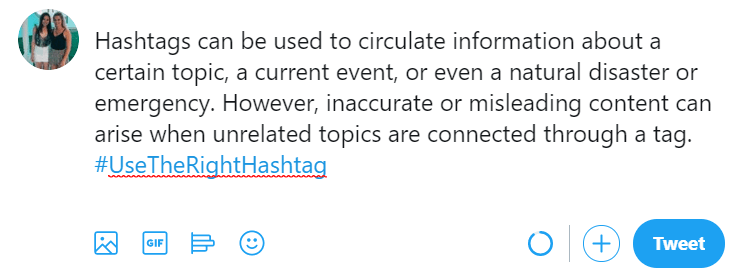
Unlike Wysocki’s approach, the approach that this chapter describes involves examining a work beyond its initial, visual delivery. The set of guiding questions that this chapter’s approach allows analyzers to think critically about where a composition may go, who might see it, and how a piece may be misappropriated. This approach can be beneficial when looking at examples from social media. Since platforms such as Twitter rely on the idea of recomposing and circulating the thoughts of others, the content posted can easily be perceived in different ways. Hashtags, for example, can help organize a theme or topic that people are discussing. However, someone could also use a popular hashtag for advertisements or other off-topic means. In our rhetorical analyses it will be beneficial to consider the questions posed in this chapter.
What argument is the author(s) making (what is their main point or what do they want you to think or do)?
I think the main argument that the authors are making in this chapter is that the audience of any text must be considered, as well as their ability to edit and share a given text. Additionally, the authors are suggesting that any type of text should be analyzed in this way as no piece of text is immune to this concept.
What are key concepts from the reading (keywords and their definitions according to the author(s)?
rhetorical velocity: the way rhetors strategize about the potential recomposition and redistribution of a text
kairotic inventiveness: an expansion that involves questions arising before the rhetor commits to words on paper as well as questions that pertain to moments after the composition is complete
What is a key quote from the reading and what do you think it means?
“By inductively strategizing how the rhetorical dominoes may fall, the rhetorician may consider potential speed and distance(s) of her own text, but also the potential speed and destination(s) for future text composed by third parties.”
This quote explains how the idea of velocity plays a role in this type of rhetorical analysis. This involves considering technical and human resources that are available in other places, how much time they may have to respond, and what might motivate others to redistribute the text.
How does this work inform either our current project or how you think about digital rhetoric–in other words, what is your take away from this reading?
The approach that this chapter describes will be beneficial for me when working on the current project. My chosen community involves the social media platform Tik Tok, which allows users to redistribute the work of others in a unique way. On Tik Tok, the type of media is videos under a minute long along with a caption. Users can “Duet” another person’s video, which allows them to create a video that shows both the duetted video and a new video. Some users use this function to make fun of someone else’s video, or simply add to it, such as performing the same dance. Additionally, the sound on someone’s Tik Tok can be reused on another video. Thus, I will analyze this type of redistribution when examining Lil Huddy and his community.
After introducing the reader to multiple media of texts, Wysocki offers a three-tiered approach for analyzing visual aspects of texts. Discuss her approach and how it might be applied to analyzing aspects of social media across different platforms or channels
Wysocki’s three-tiered approach for analyzing visual aspects of texts begins with “Name the visual elements in a text”. Depending on the type of media, this involved looking at the text itself and describing its appearance, along with the visual elements that go along with it. When looking at the visual elements on social media, this may include photographs, gifs, hashtags, etc. The next step in this approach is “Naming relationships among elements”. This includes looking at how the visuals are arranged, what draws your attention, and how these aspects interact with each other. On Twitter, the background is non-distracting so that the tweets on one’s timeline stand out and grab your attention. Lastly, the final tier is “contextualizing the elements”. In this step, you should consider how the experience of the content could be changed by simply altering a certain color or visual aspect. Additionally, it involves considering the audience and how the creator wants them to “move through” the text. On social media, brands often create posts that appeal to a certain audience. Thus, they often rely on visual aspects like color and media type to best convey their messages.
What argument is the author(s) making (what is their main point or what do they want you to think or do)?
The main point of this article is to show how different medias of text incorporate words, images, and other visual aspects. It also emphasizes that the context of these different texts often tap into a certain audience by using appealing visual aspects.
What are key concepts from the reading (keywords and their definitions according to the author(s)?
type: what is on a screen or page, it must have a particular lettershape, size, style, and overall shape.
logos: appeal to reason
pathos: appeal to emotion
ethos: the persuasive appeal of one’s character, especially how the character is established by means of speech or discourse
kairos: the opportune occasion for speech
audience: those who will hear or read a discourse, which rhetorical analysis takes into account
invention: finding something to say; closely tied to logos and what an author would say rather than how they would say something
style: the artful expression of ideas, it addresses how something is said
arrangement: how one orders speech or writing
delivery: concerning how something is said, rather than what is said
memory: closely tied to kairos, the degree to which a speaker successfully remembers something they memorized
What is a key quote from the reading and what do you think it means?
“To many, “computer game” equates with Super Mario Brothers or Diablo II which are usually wordless but not soundless and which require players to figure out increasingly complex problems in order to advance to new and more difficult levels of play; the challenge is to keep advancing so as to end with more points than anyone else, to have found all that was hidden, or to be the last one standing.”
This quote is from the section of the article about multimedia pieces. I think it is an interesting way to introduce this type of media because I do not usually think of video games when thinking of modes. This brief description of these games makes a point to say that these games are usually wordless but not soundless. Thus, it continues to demonstrate how aspects such as sound can be used to improve a game or type of media.
How does this work inform either our current project or how you think about digital rhetoric–in other words, what is your take away from this reading?
This article can be used as a guide for analyzing different types of modes. Since it contains information about all types of media, this article is very helpful and informative. Thus, I may use Wysocki’s three tier approach in an upcoming project in this class.
Drawing from examples in the readings, in what ways do platforms and modes influence the way we read, write, and circulate communications?
Platforms and modes influence how people communicate in several different ways. Social media has allowed faster and universal communication as the world is much more connected now. The rise of digital media has also been associated with the idea of multimodal writing. However, these platforms contain algorithms which can affect how information is communicated to others. Additionally, these platforms have the capability to “ban” users or draw attention around a certain topic. For example, as Gillespie describes in the article “Platforms Intervene”, certain hashtags on Twitter may be studied by researchers, but this data is leaving out valuable communication from private accounts or tweets that did not use the hashtag.
What argument is the author(s) making (what is their main point or what do they want you to think or do)?
“Platforms Intervene”
In this article, Gillespie’s main point is that although social media has circulated much communication, the platforms on which this occurs have algorithmically publicized and silenced certain content. Thus, the author is arguing that it is important to study a platform itself when examining data, and remember that it is a private company that may have certain financial, social, or political agendas.
“All Writing is Multimodal”
The authors of this article are mainly arguing that any form of communication is multimodal, meaning it uses a variety of meaning-making to convey a message. Additionally, the authors make a point to explain that there is no such thing as “monomodal” communication.
“Keeping Up with the Algorithms”
The main argument that Hutchinson makes in this article is that each social media platform uses algorithms so that users can see more engaging and relevant content. However, he explains how these algorithms can cause issues for marketers and businesses, thus showing the necessity of understanding how each algorithm works.
What are key concepts from the reading (keywords and their definitions according to the author(s)?
platform: social media outlets that guide or silence communications
algorithms: machine learning and data sorting on social media that decides what users see
censorship: purposefully restricting information, comparable to being banned on social media but the true form of it is more restrictive
public culture: the social norms that arise from social media and communications
multimodal: any combination of modes/meaning making. every form of communication is multimodal
What is a key quote from the reading and what do you think it means?
From “Platforms Intervene”: “We study what content these platforms circulate, but we too often describe it as what ‘returns’ as search results or ‘goes viral,’ rather than seeing them as the result of strategic actors selecting and assembling user content into a particular composite”
This quote stood out to me because it perfectly describes how content on social media can be skewed and exaggerated, especially on the news. However, the algorithms that likely caused a rise in a particular subject, or the idea of going “viral”, are rarely included in these reports or discussions. Thus, the lack of understanding around algorithms may distort how people view certain topics.
How does this work inform either our current project or how you think about digital rhetoric–in other words, what is your take away from this reading?
These readings helped me realize how social media platforms have evolved communication even more so than we thought. The businesses behind them have created algorithms that influence what information we see, which can be deceiving. Thus, it is important to consider all modes when looking at a form of communication- including the platform it is on and how its algorithm is designed.

 Julia McDermott IMS 224